Reading
Jesus replied: “‘Love the Lord your God with all your heart and with all your soul and with all your mind.’ This is the first and greatest commandment. And the second is like it: ‘Love your neighbor as yourself.
Matthew 22:37-39 (NIV)
Reflection
In the Scripture verses above, we’re reminded that, in Jesus’s own words, we have a rather simple statement about what’s at the center of God’s calling for our lives. Love God; love people. Even so, we soon learn that just because it’s simple doesn’t mean it’s easy to do. In fact, it seems to me that the biggest problem we face today—even bigger than some of the questions that make the headlines, such as “Will AI technology be our undoing?” or “Will the inflation rate continue to rise?”—is the problem of hate. Hate, of course, is the opposite of love; therefore, it is the opposite of God.
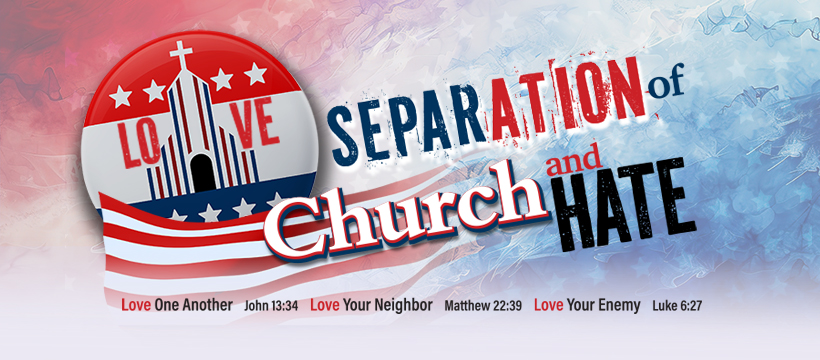
Anytime we use words that convey disdain, suspicion, demonization, or dismissal, we’re standing for hate. And standing for hate is a stance that is against God’s will for us. As we’ve stated many times before (especially during this current sermon series “The Separation of Church and Hate,” we, as Christians, cannot consider hateful treatment–through such avenues as our words, deeds, or deliberate exclusion–to be in line with what Jesus calls us to live out.
All of this sounds basic, right? And yet, so often people are okay with letting their fears and distrust dictate how they think, talk, and act. Damage is often done when people who profess to be believers in a loving God (indeed, a God who the Bible states is love) resort to stereotyping and hurling epithets, slurs, or labels. Such damage goes deep and runs rampant.
Perhaps there’s something within us that gets steered by our insecurities, such that we turn to the demeaning of others’ beliefs, ideologies, and opinions to make us feel more confident about those tenets which we ourselves continue to hold most dear. We often see this process come to a painful, disruptive, and dysfunctional apex during times of political campaigning as people gear up to cast their votes.
If we as Christian believers stand opposed to others in ways that are expressed through castigation and haughtiness, we betray our own beliefs in the wondrous power of the Christ, who was willing to give up everything in the name of humility, love, and forgiveness. That’s one reason that coming back to the basics is so important: It helps us realize that, even in the most fundamental ways of living out our beliefs, we still have a long way to go. The two main ways we can express our faith in God are to love God and love people. And we don’t have the option of doing just one. They come as a set. When we hate our brother or sister, we’re not loving them, and we’re not loving God.
I find it so helpful to meditate and pray on the verses above. It helps me realize that I have much to learn about what it means to truly accept others and to love them as I love myself. And if I allow myself to hate them, I’m not just alienating them; I’m also alienating myself. Again, it comes as a package deal.
Fortunately, I believe in a God who never gives up on me. Therefore, I can come to God each day, setting my trust upon this reliable foundation: God’s love. And all the while, I hope and pray that I might keep my eyes trained more on the servanthood of Jesus than on my own accomplishments, more on the goodness of my neighbor than on whether we have the same backgrounds or agree on all the same things, and more on how I might become a source of love in a world that contains way too much hate.
Prayer
Almighty God, help me to love those with whom I find much affinity, as well as those to whom I’ve been an aloof stranger or worse. Forgive me, Lord, for taking the basics for granted, and thereby losing sight of what path I’ve been called to walk. Lord, with humility and authenticity, may I befriend companions who are different from me, who disagree with me… and, if I’m willing to accept it, who undoubtedly have something to teach me. Amen.